

Investing Fundamentals
There is a straightforward process for finding good investment properties.
The purpose of this guide is to provide a basic understanding of real estate investing. This will enable us to focus on our upcoming Zoom meeting on working together to find and monetize properties.
This guide was written to be as short as possible. There is no fluff, just practical content. Below is a brief summary of each section:

Our 16+ year results.
We are able to consistently deliver performing properties due to a combination of data science, a team of experts, and proven processes. Below is a block diagram overview of our process. As you can see, there are many steps between our first meeting and owning a rental property. While the process diagram may seem complex, we manage the vast majority and keep you updated on the progress. You have limited direct involvement in the steps.
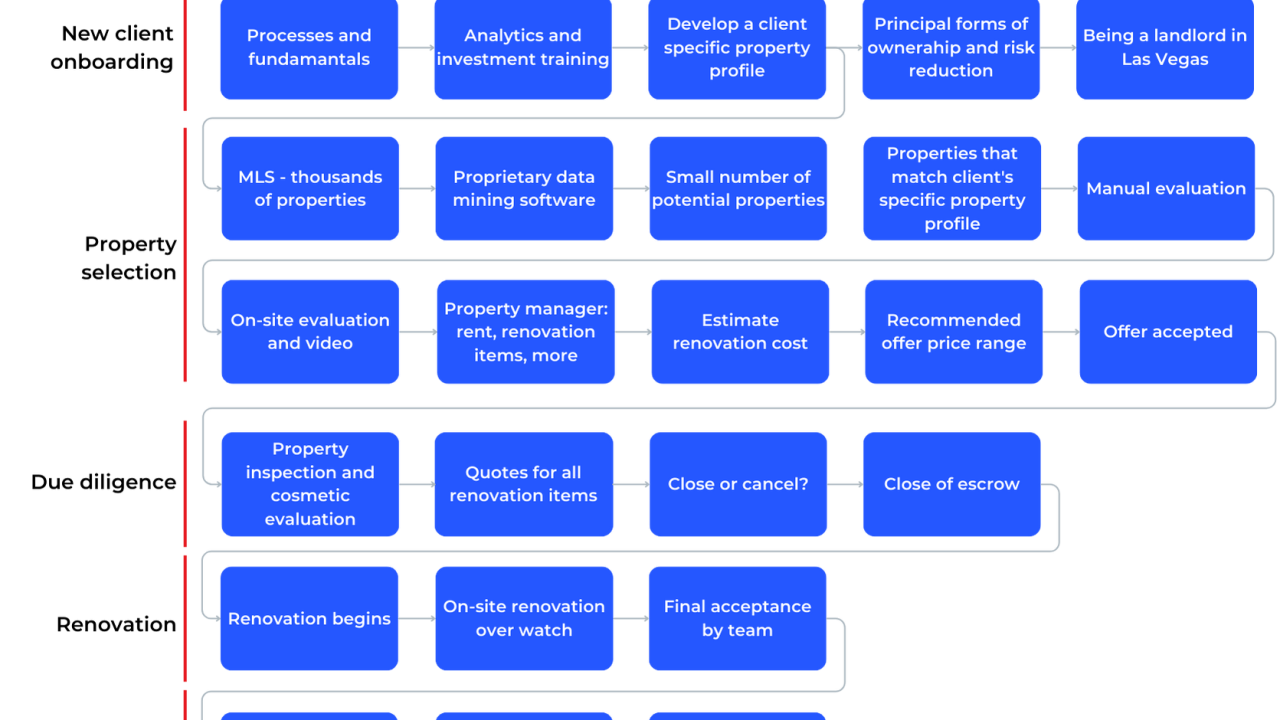
Few clients have prior real estate investing experience. Our training provides a comprehensive understanding of the analytics we offer and our processes, including strategies for expanding your portfolio with minimal capital.
Identifying reliable income properties is straightforward. There are no secrets involved. This section outlines the process we've followed to deliver over 490 high-performance investment properties.
This agreed-upon time period is for inspections and other investigations to identify potential issues and ensure you have a complete understanding of the property.
Renovation refers to the process of enhancing a property with the aim of increasing rent and reducing vacancy costs while keeping costs to a minimum.
We offer services and information usually reserved for institutional investors. This range of services is made possible by our experienced core team and our close collaboration with trusted third parties. Below, you’ll find the core team members, along with a summary of their respective areas of focus and third parties we work with most frequently.
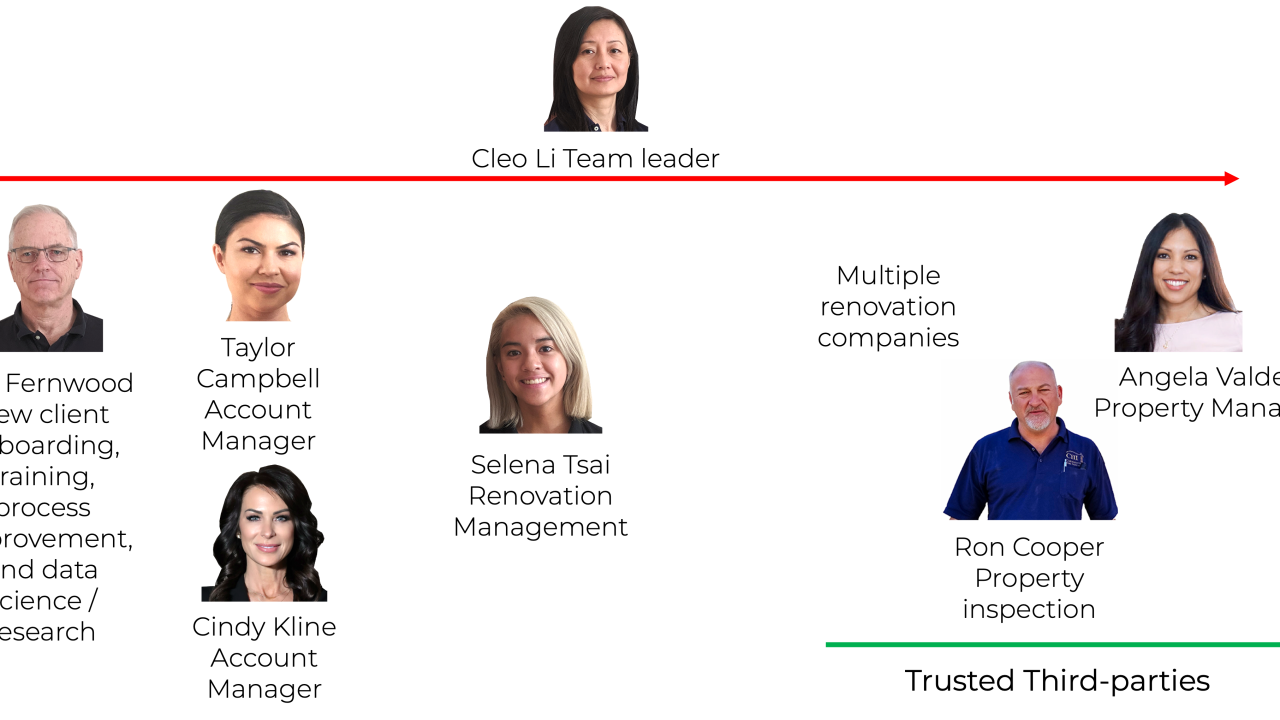
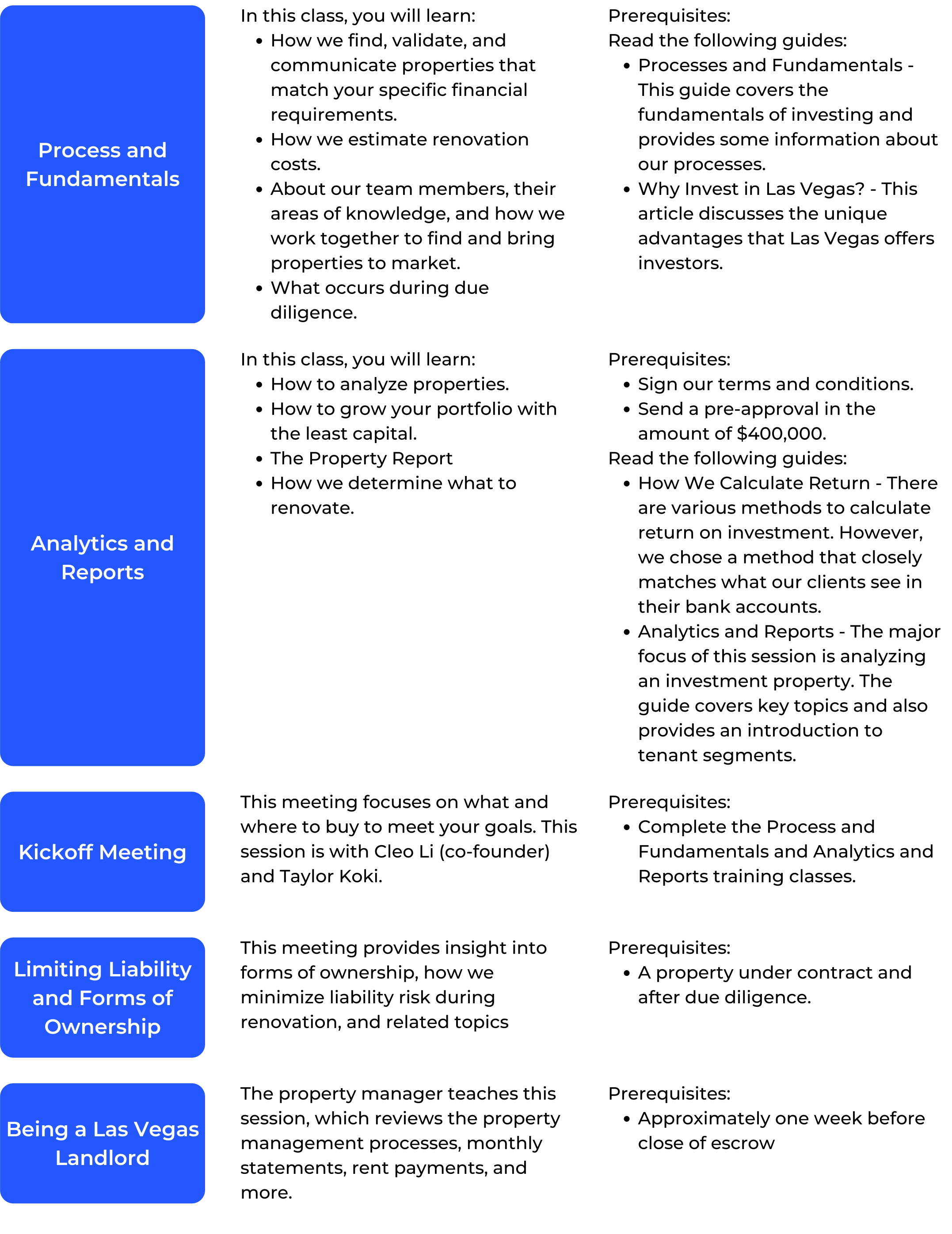
We look forward to a long-term business relationship and, therefore, commit time to educating you about investing and our processes. Our objective is to be fully transparent throughout the process, ensuring you are clear and confident at every step.
Below is a brief overview of each class and the prerequisites. Each class lasts about an hour and is a one-on-one Zoom session with a subject expert. It’s essential to use a computer or tablet during these sessions in order to see the presenter’s screen; a cell phone may be too small.
The goal of real estate investing is to attain financial freedom. This means not only replacing your current income but also generating an income that outpaces inflation so you can maintain your current standard of living throughout your lifetime. Financial freedom requires an income that meets three criteria:
The location, not the property itself, is the most crucial investment decision you’ll make. This is because the location determines all long-term income characteristics, including whether rents will keep pace with inflation, how long your income stream will last, how reliable your income stream will be, how much of your rental income is lost to overhead, and whether you or the government control your property.
The following are the requirements of a location likely to provide a reliable, lifelong passive income that outpaces inflation.
Sustained and significant population growth: Prices and rents are a function of supply and demand. Demand is driven by population growth. Where there is sustained and significant population growth, the current housing supply will not meet demand, so prices will rise until the number of sellers roughly matches the number of buyers. Where population growth is stagnant or falling, the current housing supply is sufficient, so there is little increase in prices. Property prices drive rents — where prices are low, more people can buy, so there is little demand for rentals and limited or no rent growth. Where prices are higher, more people are forced to rent, so rents increase. In the best locations, rent growth keeps pace with inflation. Never invest in any city with a static or declining population.
Population greater than 1 million: Smaller cities may rely too much on a single business or market segment. Larger cities tend to be more stable economically during economic turbulence.
Low crime: A rental property is no better than the jobs around it — and not just the current jobs. The average lifespan of a company is ten years, and an S&P 500 company only has an average lifespan of 18 years. Every job your tenants have today will disappear in the foreseeable future. Without new companies moving into the city and creating replacement jobs, the only jobs left will be low-paying service sector jobs, and companies wanting to set up new operations will not choose high-crime cities. Never invest in any city on Neighborhood Scout’s list of the 100 most dangerous cities.
No rent control: Some states and metro areas have implemented various kinds of rent control. Rent control may prevent you from increasing the rent fast enough to keep pace with inflation, limit your property manager’s ability to select the best tenant, and make evictions of non-performing tenants difficult or impossible. Never invest in any city with rent control.
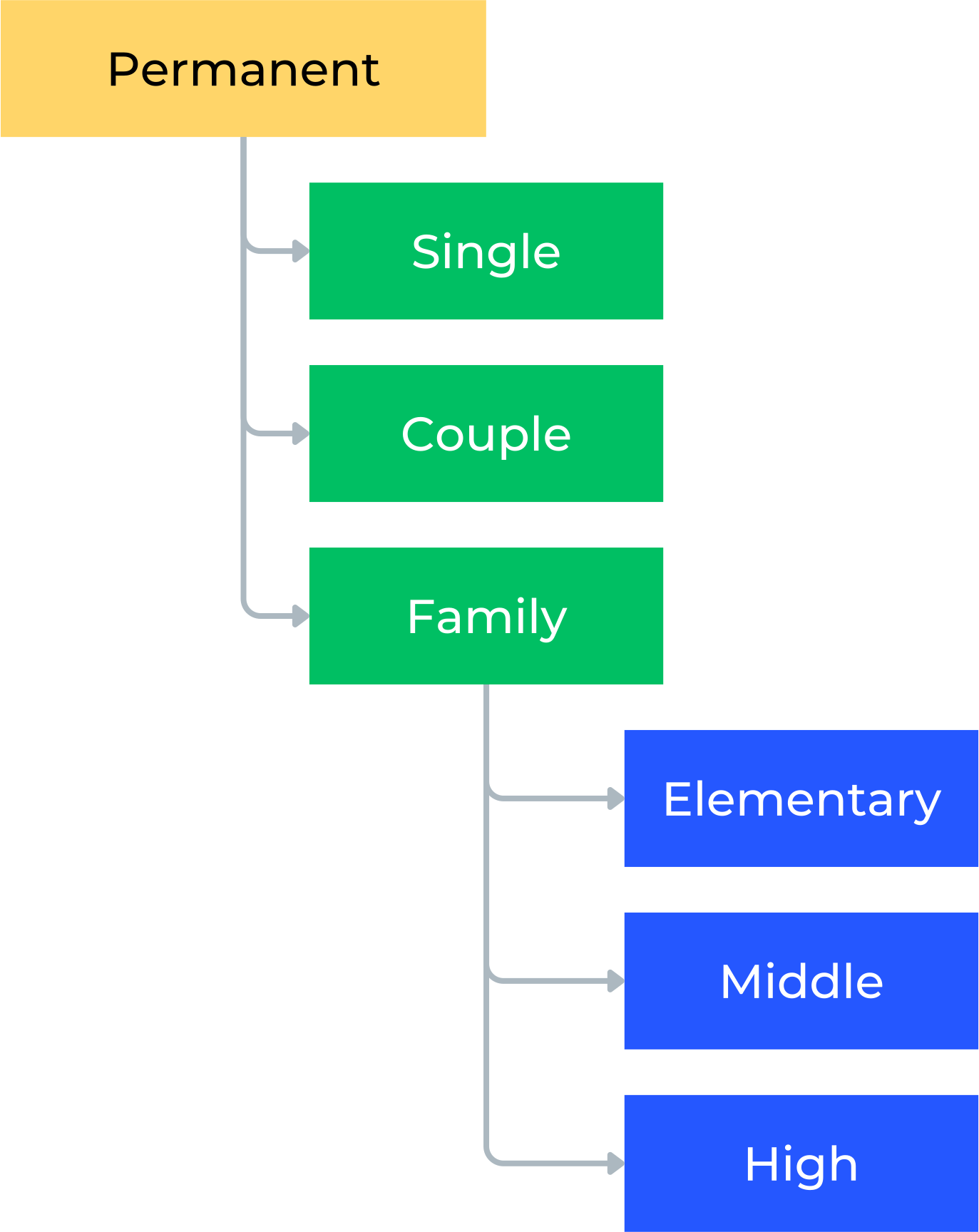
There is a belief that all people who rent have common characteristics. This is not true. There are three primary tenant segments in Las Vegas; we target a subsegment of the Permanent segment. Each segment has sub-segments, and every subsegment has distinct housing needs — a family of three, for example, is unlikely to rent a one-bedroom condominium.
The reverse is also true: a property typically only matches the housing requirements of a single-tenant subsegment. Only when the housing characteristics match the tenant segment housing requirements will the tenant rent the property.
How do you target a specific tenant segment or subsegment? By selecting a property that matches that segment’s specific housing requirements. This is what we did to target a specific tenant segment to meet the requirement for income reliability.
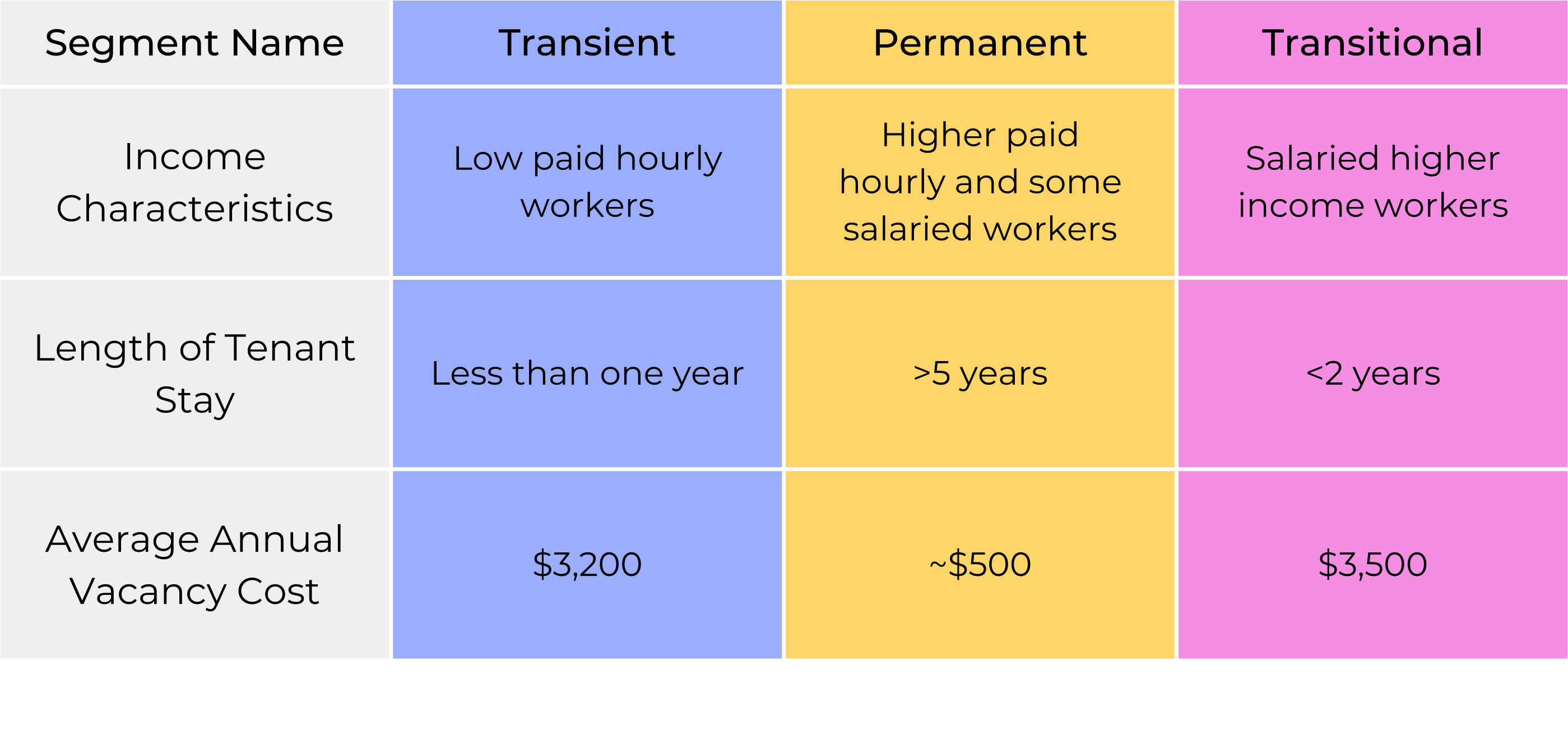
Three primary tenant segments exist in Las Vegas, summarized in the diagram below.
Each segment has sub-segments, as shown below.
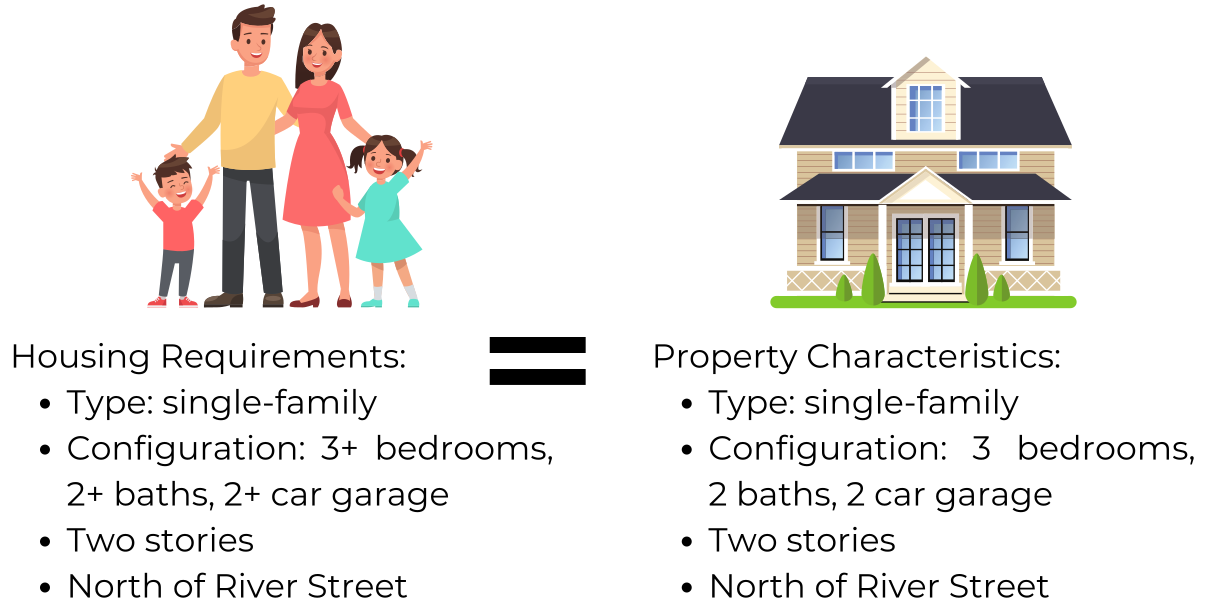
Below is an example in which the property meets the housing requirements of a particular segment.
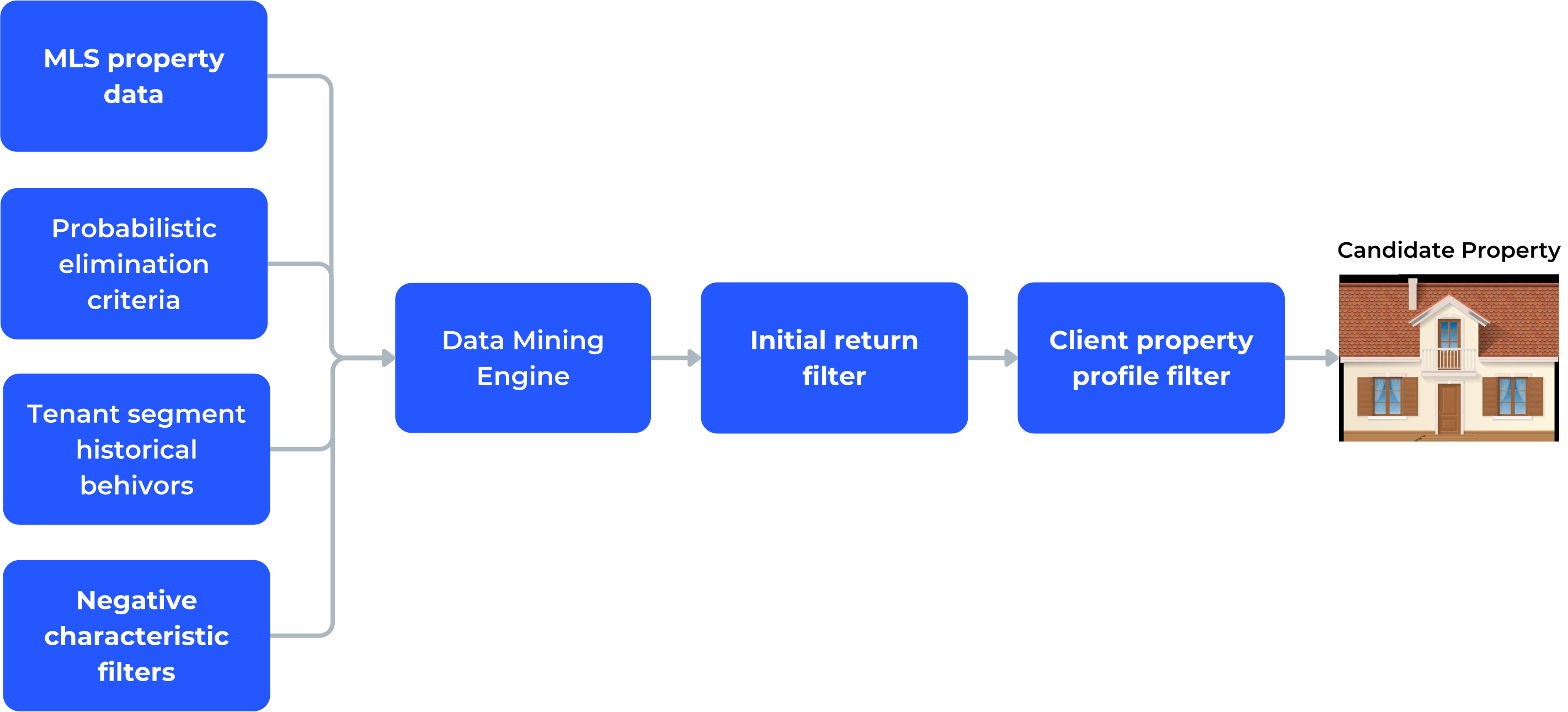
In 2005, extensive demographic research identified a segment with a high percentage of reliable tenants — starting with subdivisions with an average tenant stay of over five years, then a correlation analysis to determine common characteristics. Our data mining engine evaluates each property against approximately 40 segment housing requirements and behaviors for our target segment.
Characteristics of the segment we target:
Higher-skilled jobs, direct income producers or government employees. Wages significantly higher than minimum wage, but not enough to afford to buy a home. Rarely laid off even in the worst economic times, since their skills are not easily replaceable. Families with elementary school-aged children — children anchor families to a specific location for many years.
| Characteristic | Requirement |
|---|---|
| Type | Single-family |
| Configuration | 3+ bedrooms, 2+ baths, 2+ car garage |
| Stories | One or two |
| Location | Within any of multiple well-defined areas |
| Size | 1,200 to 2,100 SF |
Matching all the segment housing requirements and behaviors for our target segment is not sufficient on its own — see Property Selection below.
While there may be many properties listed on the MLS, only about 0.4% are worth further consideration. Once a property is identified as a candidate, it enters manual evaluation. It takes about one day from the time a property comes on the market to when it is thoroughly evaluated and sent to you. If our offer is accepted, the evaluation continues into the due diligence phase.
Below is a simplified diagram illustrating how a property is identified as a candidate investment property.
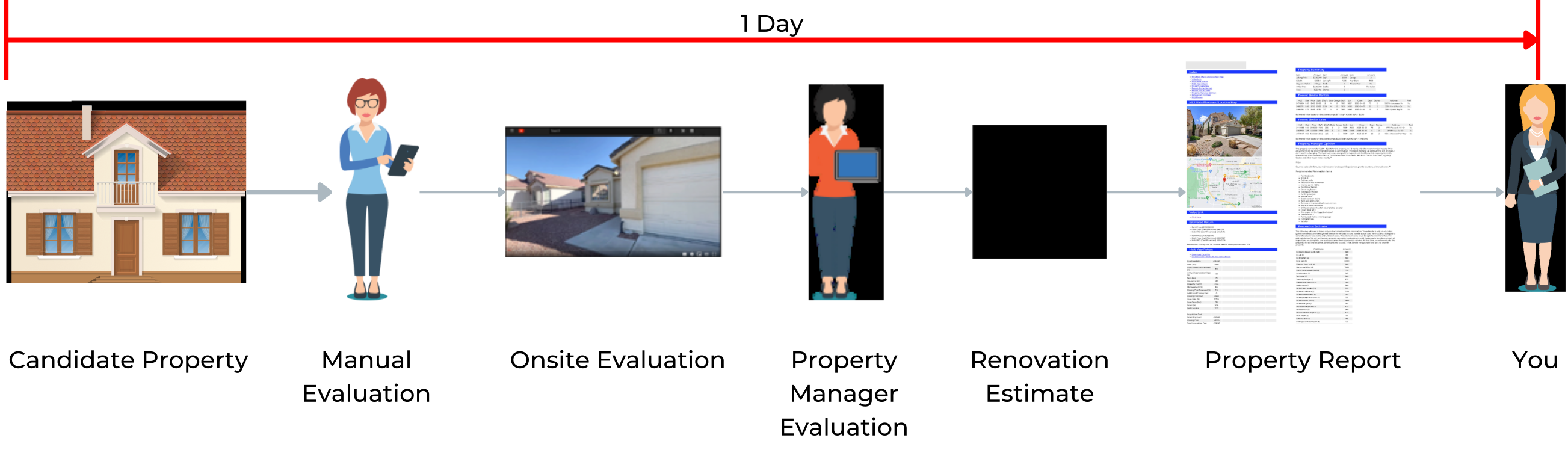
Once identified, the property is thoroughly evaluated before an offer is made.
During the due diligence phase, which is nominally ten days, there are a minimum of two inspections. The property inspection is performed by a licensed property inspector, focused only on systems (HVAC, plumbing, electrical, etc.). The cosmetic inspection focuses on cosmetics and is performed by a team of people.
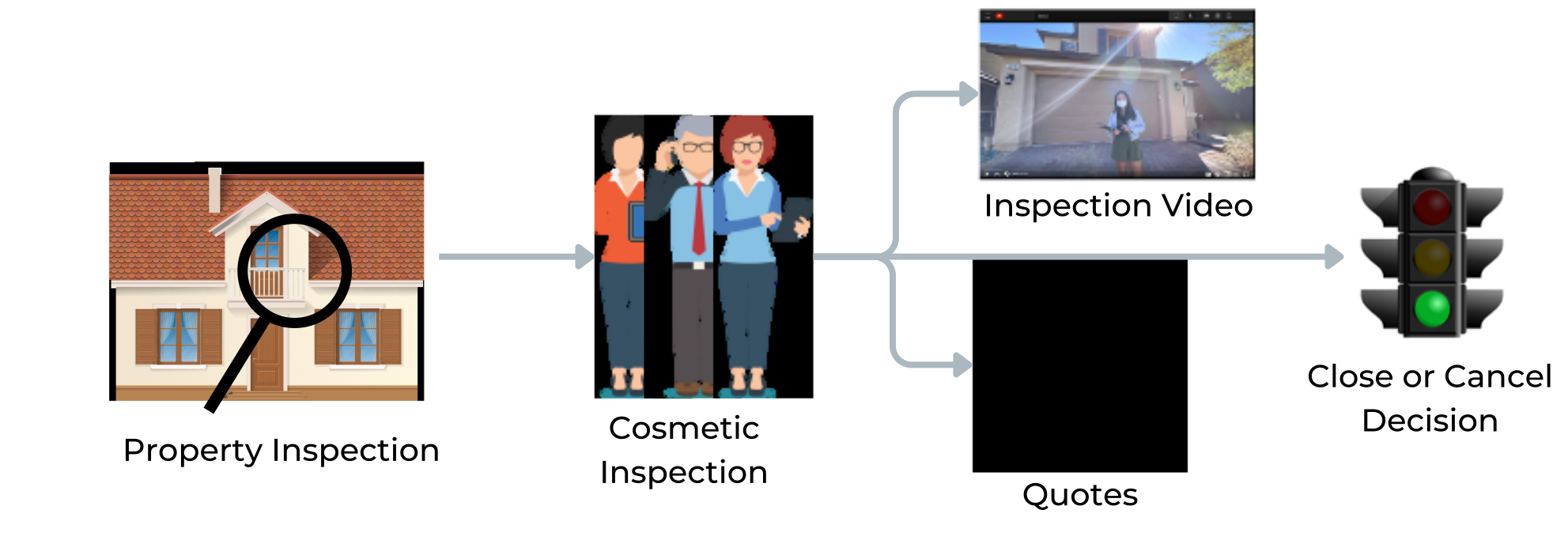
At this time, we know a lot about the property and will re-evaluate it to determine whether to close or cancel the purchase and look for another property. If the cancellation occurs during the due diligence period, your earnest money will be refunded. However, you will lose the inspection cost, which is approximately $375. If you are financing, you will likely also lose the appraisal fee, ranging from $600 to $800.
Explains the implications of items listed in the inspection report.
A 7 to 15-minute video of the property manager evaluating the property, with the inspector present.
A quote for all renovation items.
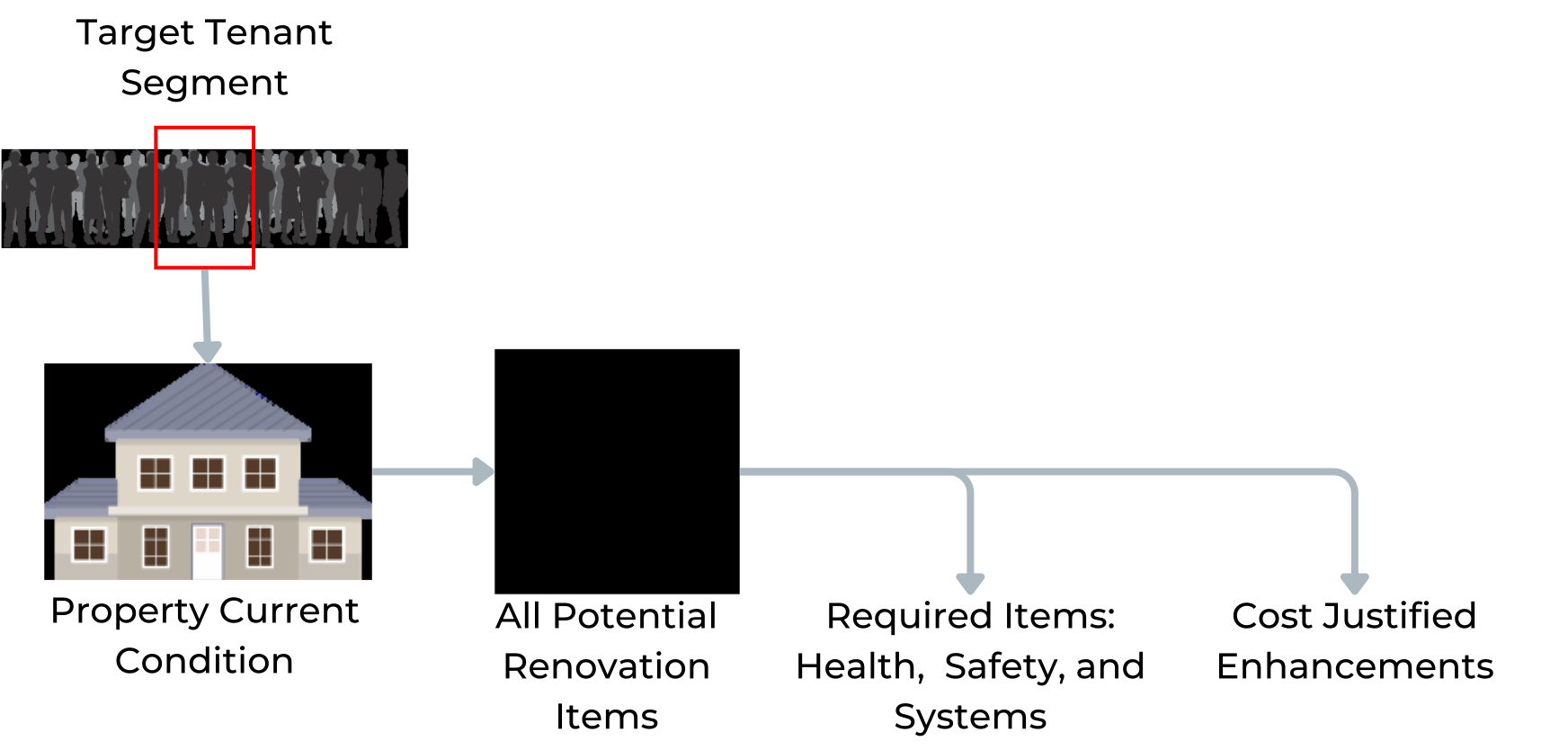
Renovation is the process of transforming a property to eliminate health and safety issues, attract the right tenant pool, increase rent, decrease time to rent, increase the length of tenant stay, and reduce maintenance costs.
The potential list of renovation items is the difference between the market-ready condition and the current condition. A property is considered market-ready when a significant part of the target tenant group is both willing and able to rent the property at its full market value — market-ready conditions are specific to the tenant segment. The potential list of renovation items is divided into two categories: required items and enhancements. Required items include everything necessary to make the property safe and minimize litigation risk.
Enhancements are items that are cost-justifiable based on the payback period. For example, suppose the property has laminate counters in the kitchen. If the property manager predicts that the property will rent for $2,000 per month with laminate counters and $2,200 per month with granite counters, and the cost of granite counters is $3,000, the payback period is calculated as follows: $3,000 / ($2,200 − $2,000) ≈ 15 months.
In general, enhancements with a payback period of less than three years are worth paying for. Over four years, it is difficult to justify the cost unless there are additional considerations.
Thank you for reading this guide. You now have a basic understanding of our processes and fundamentals.
In our upcoming Zoom meeting, I will explain our processes in more detail, and we can address any questions you might have. See you soon — Eric Fernwood, Eric@FernwoodTeam.com, 702-358-8884.
There is a straightforward process for finding good investment properties.
Real estate investing consists of three phases, each centered around a specific step towards achieving financial independence.
I’ve sold more than 470 investment properties. I don’t recall a single one performed poorly, even during turbulent times. The reason?