
Achieving Your Passive Income Goal with Less Capital


Photo by Min An from Pexels
The first step in any plan is to define the goal. Your goal might be a passive income stream of $10,000/Mo. If so, you will need to acquire multiple properties based on an assumption of a specific amount of cash flow per property. For example, if you assume that the cash flow from each property is $500/Mo, calculating the number of properties you need to acquire is simple. $10,000/Mo / $500/Mo/Property = 20 properties. The next question is how much total capital you will need to buy 20 properties?
If I assume that your cash out for each property is $100,000, you will need $2,000,000 to acquire 20 properties. However, if you buy properties in a rapidly appreciating market, you can significantly reduce your total capital expenditure.
To demonstrate the capital reduction appreciation can provide, I put together a simplified example. In this example, there are two properties. Property A appreciates 10% annually, but has zero cash flow. Property B has zero appreciation, but rent increases 10% annually. I also made several other assumptions to keep the example simple.
- Combined state and federal income tax rate is 30%.
- Purchase price: $400,000.
- Down payment on real estate: 25%
- Acquisition cost: $100,000 (25% x $400,000)
- No inflation
- No loan costs
- No closing costs
- No vacancies
- No renovation cost
- No maintenance cost
- No management expenses
Below are the two models.
| Property A – No Cash Flow | Property B – No Appreciation | ||
|---|---|---|---|
| Appreciation | 10% | ROI (%) | 10% |
| Market Value | 400000 | Annual cash flow | 10000 |
| End of year 1 | 440000 | Taxes (@ 30%) | -3000 |
| End of year 2 | 484000 | Annual after tax cash flow | 7000 |
| End of year 3 | 532400 | Investable Cash after 3 Years | 21000 |
| 75% cash out refi | 399300 | ||
| Pay off existing loan | -300000 | ||
| Investable Cash after 3 Years | 99300 | ||
As you can see, even with an extremely high cash flow (10%), the amount of investable cash you have at the end of 3 years is a fraction of what you will have due to appreciation.
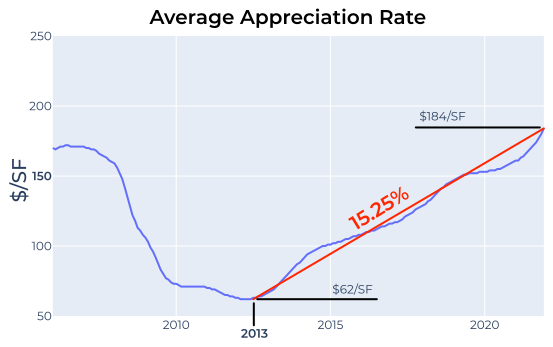
If you think 10% annual appreciation is unrealistic, below is the 9 year average appreciation for our property segment in Las Vegas. If you only look at 2021, the appreciation rate was 32%.
So, what would the acquisition cost look like if we assumed you refinanced each property at the end of every 3 years?
| Year # | Cash Invested | Number of Properties in Production | Total Monthly Cash Flow at $500 per Property |
|---|---|---|---|
| Year 1 | 100000 | 1 | 500 |
| Year 4 | 2 | 1000 | |
| Year 7 | 4 | 2000 | |
| Year 10 | 8 | 4000 | |
| Year 13 | 16 | 8000 | |
| Year 16 | 32 | 16000 |
While the above example is over simplified, it does show the power of appreciation. Some other considerations:
Is 10% rent growth reasonable? Below is a chart showing 10 year rent growth for our property segment in Las Vegas. As you can see, 10% rent growth is not unrealistic.
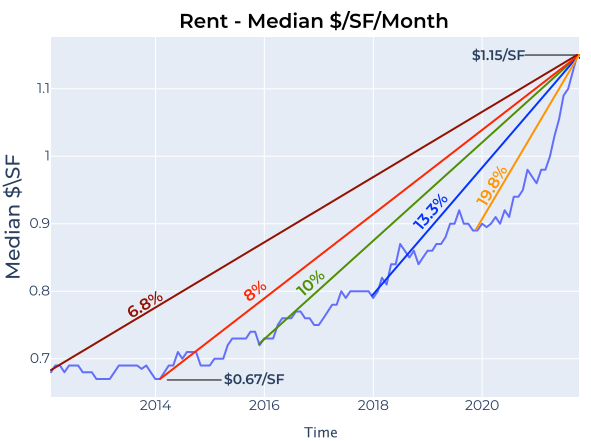
In a rapidly appreciating market, rent will increase each year so the actual number of properties you need to achieve $10,000 may decrease over time. It depends on the rate of rent increase and the inflation rate. See the table below which shows the total monthly cash flow for a given number of properties if I include 10% rent growth. So, based on the assumptions, you would meet your $10,000/Mo. goal at about year 11 with only 8 properties. However, this is an overly simplistic example.
| Year | Number of Properties in Production | Cash Flow Per Property | Total Monthly Cash Flow |
|---|---|---|---|
| Year 1 | 1 | 500 | 500 |
| Year 2 | 1 | 550 | 550 |
| Year 3 | 1 | 605 | 605 |
| Year 4 | 2 | 665 | 1330 |
| Year 5 | 2 | 731 | 1462 |
| Year 6 | 2 | 804 | 1608 |
| Year 7 | 4 | 884 | 3536 |
| Year 8 | 4 | 972 | 3888 |
| Year 9 | 4 | 1069 | 4276 |
| Year 10 | 8 | 1175 | 9400 |
| Year 11 | 8 | 1292 | 10336 |
| Year 12 | 8 | 1421 | 11368 |
| Year 13 | 16 | 1563 | 25008 |
| Year 14 | 16 | 1719 | 27504 |
| Year 15 | 16 | 1890 | 30240 |
Many expenses such as renovation, maintenance, insurance, taxes, and management fees were ignored in this example. However, except for renovation, all expenses should be covered by the cash flow. The impact of these expenses is that your cost to acquire properties will be higher than in the model, which would either lengthen the time between refi’s or require additional capital.
Reality
While the above proves the power of appreciation, in the real world there are additional costs. However, depending on reasonable assumptions for the following, a realistic model can be built:
- Amount of initial investment
- Amount of annual investment
- Your tax rate over the investment period
- Inflation rate over the investment period
- Interest rate over the investment period
Renovation cost
Appreciation rate over the investment period
- Present value monthly income goal
- Rent growth rate over the investment period
- Availability of attractive financing over the investment period
Summary
As long as you buy in a high appreciation market, you can greatly reduce your total capital investment using cash out refi’s. Cash flow, beyond all expenses, can be accumulated to acquire additional properties.
If you would like to develop a plan for your specific situation and goals, book a Discovery Call with me.
Related insights

Common Mistakes Beginner Real Estate Investors Should Avoid
3 min read This article highlights common mistakes beginner real estate investors should avoid to maximize their chances of success. Understanding these pitfalls can…

The Advantages of Investing with Fernwood for Passive Income
5 min read Unlocking Passive Income: The Advantages of Investing with Fernwood In a fast-paced world where busy professionals often find it challenging to…

New to Investing? What to Know Before You Hire a Property Manager
Before hiring a property manager, it’s crucial to understand their role and the value they bring to your investment. A good property manager goes…
Thinking about a Las Vegas rental?
A 30-minute conversation about your goals: whether Las Vegas fits your strategy, what a first property costs, and what the process looks like.
- We learn your goals and make sure we’re the right fit
- You get a clear picture of cash requirements and realistic returns
- You leave with next steps, whether or not you work with us